
What Are Equations, Exactly?
Any equation consists of two expressions with one or more variables joined by an equals sign. In physics, equations describe relationships between different real-world phenomena represented by variables or constants.
That’s where the main difference between an equation for physics and math lies. In math, equations are used simply to find unknown variables. In physics, equations represent the laws of nature. Think of them as a real-world application of math equations.
While they serve somewhat different purposes, you’ll have to rely on your math prowess to solve physics equations from time to time. If you’re not a master of equation-solving yet, check out our physics AI solver — it’ll help you refine your skills!
5 Most Important Physics Equations to Know
There are many ways to define the importance of a physics equation. Some equations are important because they’re key to physics 101; you can’t move forward without learning them by heart first.
Those won’t be the equations we’ll be listing below. Instead, we’ve decided to focus on the equations that were truly revolutionary for their time, transformed the field itself, and paved the way for new domains of physics.
Einstein’s Mass-Energy Equivalence
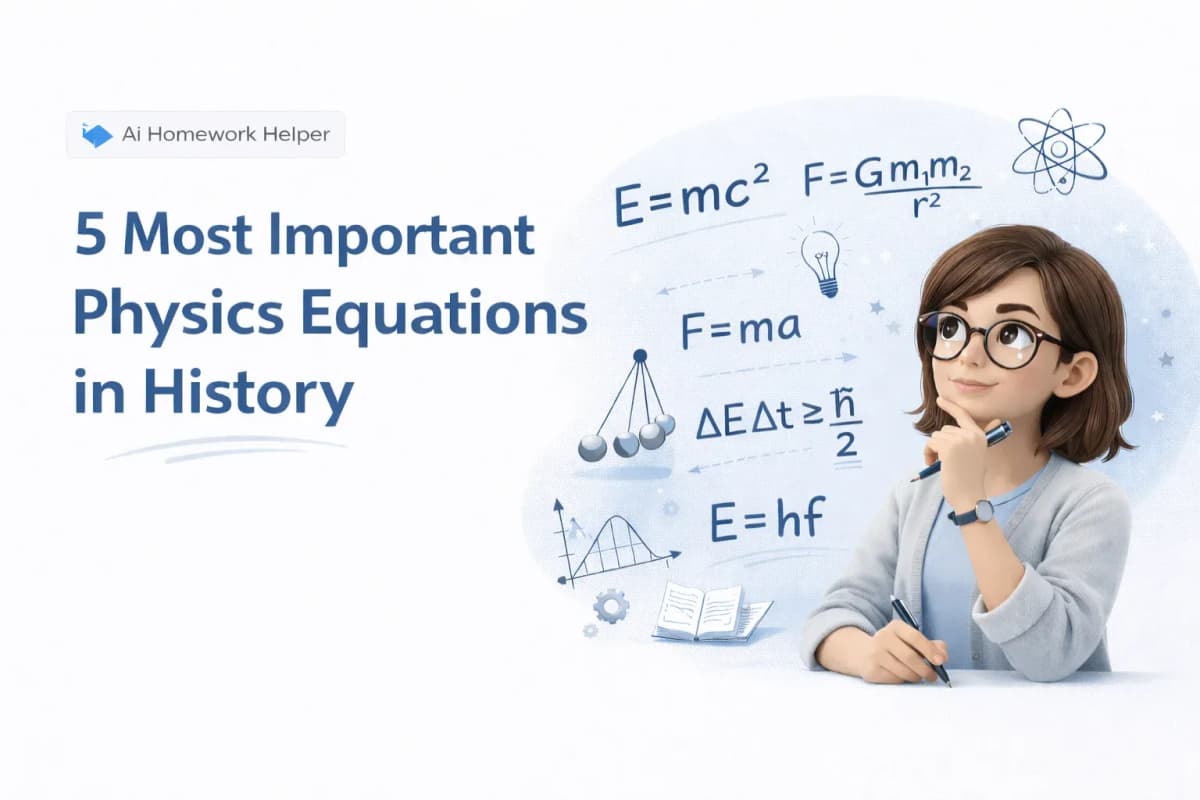
E = mc² could easily be the most famous equation in physics. You’ll see it everywhere: on posters illustrating physics, in movies and TV shows, and more. While its fame as a pop culture reference is a separate topic, this equation was truly revolutionary for its time. It paved the way for nuclear and particle physics and had massive implications for astrophysics.
This equation describes the relationship between mass and energy, with E standing for energy, m signifying mass, and c² referring to the speed of light squared. Once you consider that the speed of light amounts to 299 792 458 m⋅s−1, one thing becomes obvious thanks to this equation: even the tiniest objects at rest contain huge amounts of energy.
Without the breakthrough this equation represents, we wouldn’t have nuclear power or nuclear weapons. But while Einstein’s name is associated with it (he was the first to write it down), he wasn’t the first to come up with an idea that energy and mass were related. Isaac Newton theorized about the correlation between the two, for example.
Be careful: you might stumble upon an idea that this equation means that you can convert matter into energy. That’s a misconception !
Planck’s Energy-Frequency Equation
You probably won’t know that much about Max Planck’s work unless you study quantum mechanics. But his equation, E = hv = hf, deserves to be called one of the most important physics equations. Why? It’s one of the foundational equations in all of quantum mechanics, without which the field probably wouldn’t even exist.
(This equation is just one of the many contributions Max Planck made to the field. He’s even called the father of quantum theory!)
This equation was proposed as a solution to the black-body radiation problem. It essentially states that the photon energy (E) is directly proportional to its frequency (v or f). The h in the equation stands for the Planck constant, which equals 6.62607015×10⁻³⁴ J⋅Hz−1.
Without Planck’s equation, physicists wouldn’t have been able to describe all the frequencies in the electromagnetic spectrum. Those frequencies include microwaves, radio waves, infrared waves, ultraviolet, gamma, and X-ray waves.
Ergo, you have Planck to thank for such staples of modern life as a microwave or technological advancements like imaging techniques, laser technology, and electronics!
Newton’s Second Law
Yes, we know that Isaac Newton penned three laws of motion, but his second law stands out as one of the most important equations in physics. This law, noted as F = ma, states that the change in the momentum of a moving body is proportional to the force exerted on it. That force (F) is determined by its mass (m) and acceleration (a). Quick sidenote: a stands for acceleration, not velocity. Acceleration is a change in velocity.
This equation is notably older than the first two on our list. Where Einstein’s and Planck’s equations came to be at the beginning of the 20th century, Isaac Newton formulated his laws over 300 years ago. Today, they are axioms describing how objects (including celestial bodies) move, but back then, they were quite revolutionary. In fact, they laid the groundwork for both classical physics and astrophysics.
You can see this particular equation in action in your everyday life. For example, it decides how far the tennis ball will travel after the player hits it. It’s also instrumental in designing the car’s acceleration. Since mass determines the amount of force required for acceleration, engineers use it to design engines.
Maxwell-Faraday Equation
Yes, you probably won’t see this equation (∇×E = - ∂B/∂t) on t-shirts. For that matter, you probably won’t see any of Maxwell’s equations referenced in pop culture — but that doesn’t make them any less important.
This particular equation is one of the foundations of classical electromagnetism. It posits that a magnetic field always accompanies an electric field, with ∇ × being the curl operator, E(r, t) the electric field, and B(r, t) the magnetic field. (As for r and t, they stand for functions of position and time, respectively.)
What was so revolutionary about this equation, you might wonder? Well, back in the mid-19th century, when Maxwell was working on this and other equations, electricity wasn’t a common good; it was a lab curiosity. Yes, other physicists like Faraday and Ampere had been dipping their toes into the links between electricity and magnetism. But there was no unified law or theory to describe that relationship. Maxwell changed that with this equation.
The Maxwell-Faraday equation is the foundation of all the modern technology that uses electromagnetism, from X-ray machines to MRIs. In fact, virtually any electronic and electric device relies on this very equation to function.
The Schrödinger Equation
In January 2026, this equation turned 100 years old, ironically making it the youngest on our list of popular physics equations. Its simpler, time-independent form is ĤΨ = EΨ, where Ĥ is the Hamiltonian operator, E is the energy of a particle, and Ψ is the wave function.
Simply put, the Schrödinger equation describes how atoms, electrons, and other particles move in quantum physics. Its time-dependent form shows how a given system changes with time, while the simpler version we provided above usually helps find allowed energy levels in systems that don’t change.
This equation is the foundation of modern quantum mechanics, helping predict how particles behave on the atomic and even subatomic level. In chemistry, it helps forecast chemical bonding.
Without this equation, we wouldn’t have semiconductors, which are integral to whatever electronic device you’re using to read this blog post. It also enables researchers to create lasers, superconductors, and more.
Why Pay Attention to These 5 Important Physics Equations?
All entries on our list are fundamental physics equations for their respective domains. For example, the Schrödinger equation is often called as important to quantum mechanics as Newton’s laws of motion were to classical mechanics.
To put it simply, fully understanding these equations is as important as knowing how to find the value of x in a triangle in geometry. If you don’t do your due diligence and learn to use them, you’ll keep getting stuck when working on more advanced assignments — and you’ll have to return to these equations time and time again.
Our advice is this: always cover the basics before moving on to the more advanced stuff. Imagine your physics knowledge as a house. To build it, you first have to lay the foundation. Do it too hastily, and that foundation will be too brittle to support the rest of the structure.
Final Thoughts
These five equations are no doubt fundamental for their respective domains, but they’re just some of the most important physics equations. For example, we haven’t touched on Heisenberg’s uncertainty principle, the law of entropy, or Einstein’s field equations. Don’t hold it against us, though: there’s only so much we can describe within a single blog post!
Throughout your journey through the world of physics, you’re bound to come across many more equations, and each and every one of them will be important in its own way. So, take your time to study each of them; make sure you know what each variable stands for and when to use each equation.
And if you ever need a bit of extra guidance along the way, you can always explore our recommendations for the Best AI Homework Helper tools to support your learning.