
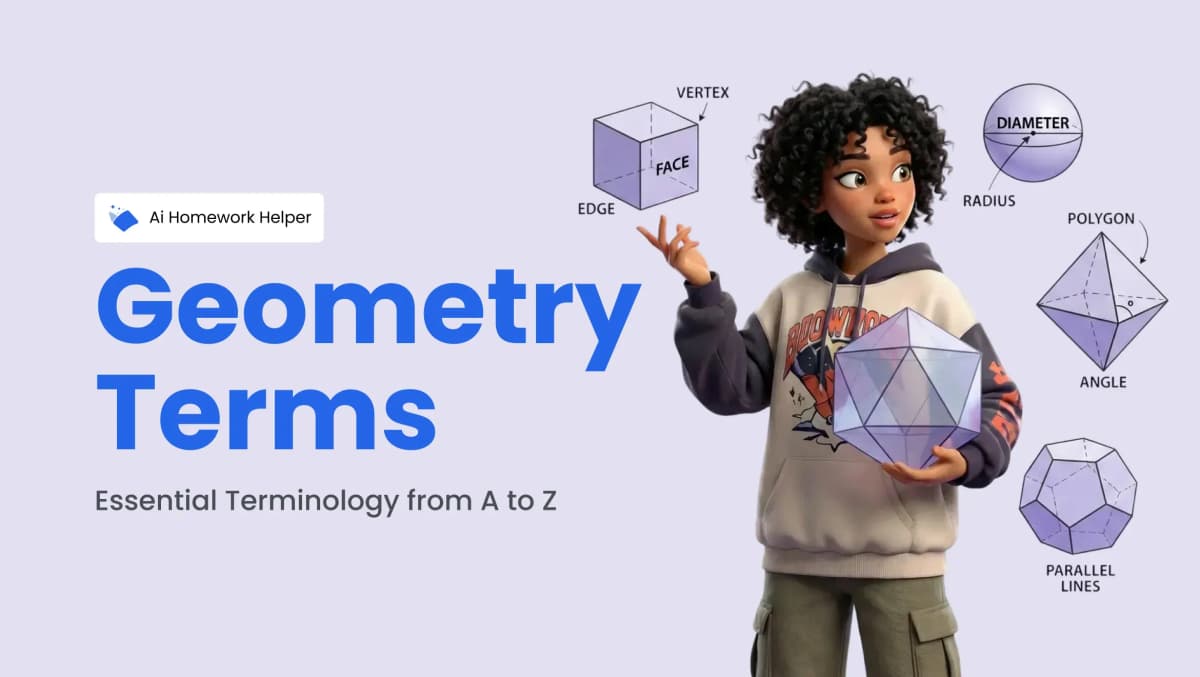
Basic geometry terms from A to Z
We are well aware of how many students struggle with geometry and want to make things as easy as we can for them. Let’s face it – if you’re an aspiring writer or a nurse, you don’t really need to know what an equilateral triangle is, at least not by heart.
We’ve used the alphabetical system to organize common terms you might need for your geometry classes. This will help you easily find the term you need and get a concise definition.
Also, if you’re more interested in practice than theory, we recommend trying our AI Geometry Solver. It will cut the time you spend on homework and help you understand geometry.
Key geometry terms that start with A
- An angle is a figure shaped by two rays that meet at one endpoint; this endpoint is referred to as the vertex. Angles describe corners and turns and are typically expressed in degrees (e.g., a 90-degree angle).
- An acute angle is any angle that measures more than 0 degrees and less than 90 degrees. It’s referred to as acute because it looks sharp and narrow compared to other angles.
- An axis is a straight reference line used to measure or rotate shapes. In coordinate geometry, axes are used to define position on a plane (x-axis and y-axis).
Main geometry terms that start with B
- A base is a side of a geometric figure used as a reference when we describe or measure a shape. Contrary to popular belief, depending on orientation, any of the sides can be looked at as the base.
- A bisector is a line (or ray) that goes through the middle of a segment or angle and cuts it into two equal halves.
- A boundary is the set of points that form the outer limit of a geometric figure.
- A box is one of the three-dimensional shapes. It’s more formally referred to as a rectangular prism and consists of six rectangular faces. All opposite faces of a box are equal and parallel.
Important geometry terms that start with C
- A circle is one of the most basic two-dimensional shapes. The distance to the center is the same for all points of a circle (see “radius”).
- Circumference is the distance around the edge of a circle.
- Congruence is the property of two identically shaped and sized geometric figures that have the same shape and size. Their sides and angles are all equal.
- A coordinate plane is a grid formed by two number lines, the x-axis and the y-axis, which are perpendicular. Without the z-axis, it’s two-dimensional. The coordinate plane is often used to graph lines, shapes, and equations in both geometry and algebra.
Essential geometry terms that start with D
- Diameter is a segment that connects two points on a circle and passes through its center. It is the circle’s longest chord.
- Dimension is a measurable extent of a shape. The main dimensions are length, height, or width. One-dimensional figures have only length (e.g., a ray); two-dimensional figures have length and width (e.g., a circle); three-dimensional figures also have height (e.g., a cylinder) or depth (e.g., a box).
- A degree is a unit that expresses angle measure. It describes how wide or narrow an angle is.
Common geometry terms that start with E
- An edge is a line segment that connects two of a three-dimensional shape’s faces.
- An ellipse is a smooth, oval-shaped curve formed by extending a circle in one direction.
- An equilateral triangle is a triangle in which all sides are the same length and all angles measure exactly 60 degrees.
- An endpoint is the end of a ray, which only has one, or a segment, which has two on both sides. It’s what differentiates a ray and a segment from a line: a line has no endpoints.
Key geometry terms that start with F
- A face is a surface that forms part of a three-dimensional figure. For example, a face of a cube is a square, and each cube has six faces.
- A figure is any geometric shape or form. Even a one-dimensional form, such as a line, can be called a figure, whereas the term “shape” is used for the figures that have an enclosed area or volume.
- A focus is a special point used to define certain curved shapes, primarily ellipses and parabolas. It predicts how the curve of the shape behaves.
Main geometry terms that start with G
- A graph represents a mathematical relationship. It’s shown on a coordinate plane.
- A grid is a system of evenly spaced lines crossing each other to form a series of squares or rectangles. Grids help us draw shapes and measure distances.
- The golden ratio is a value ~1.618 that appears when a line is split so the larger segment has the same proportional relationship to the smaller segment as the entire line has to the larger segment. It’s used in design and art to create visually pleasing proportions.
Important geometry terms that start with H
- Height is the perpendicular measurement from a figure’s base to its top.
- A hypotenuse is the side opposite the right angle in a right triangle. It’s longer than the other two sides.
- A hexagon is a polygon with six sides. All of its interior angles add up to 720 degrees.
- The horizon line is the level line that separates the ground from the sky in perspective drawings. It’s used in geometry for establishing vanishing points and perspective grids.
Essential geometry terms that start with I
- Intersecting lines are two or more lines that cross in a specific place, which is referred to as “an intersection.”
- An isosceles triangle is a triangle that has two or more sides that are equal. So, an equilateral triangle is still considered an isosceles triangle.
- An interior angle refers to the angle where two sides meet inside a polygon. The total that all interior angles add up to depends on the number of sides. For example, it’s 180 degrees for triangles and 360 degrees for all quadrilaterals, such as squares.
Geometric terms might seem overwhelming at first, but if you're asking yourself Is college statistics hard?, check out our detailed article — it breaks down exactly what to expect and how to prepare.
Common geometry terms that start with J
- A jagged line is a line that consists of short, sharp angles (as opposed to smooth curves or straight segments).
- A joint is a point where several edges or segments meet. The difference between an intersection and a joint is that joints are within the same figure, whereas intersections are between two or more figures.
- A Jordan curve is a closed, unbroken curve in a plane that never crosses itself (e.g., a circle). It’s what divides the plane into an interior and exterior area.
Key geometry terms that start with K
- A key point is an important point in a geometric figure that helps us define or construct it. For example, vertices and points of intersection can be considered key points.
- A kite is a four-sided shape with two separate pairs of neighboring sides of the same length.
- A knuckle (vertex joint) is a point where edges or lines meet, similar to a vertex. It helps define corners in three-dimensional shapes.
- A Klein bottle is a one-sided surface studied in advanced geometry that shows unusual properties of shapes. It has no clear inside or outside and can’t exist in three-dimensional space without crossing itself.
Main geometry terms that start with L
- A line refers to a geometric figure that stretches endlessly in two opposite directions and has only one dimension – length. It is defined by any two points on it. A line with an endpoint is a ray.
- A line segment is a line fragment with two endpoints. Unlike a line, it’s finite and has a specific length.
- A locus is the set of all points required for a specific geometric condition. For example, all points equidistant from a center form a circle.
Important geometry terms that start with M
- A median is a segment drawn from a triangle’s vertex to the midpoint of the side across from it.
- A midpoint refers to the point that lies exactly halfway along a line segment.
- A mirror line is a line of symmetry that allows a figure to be reflected in such a way that one side precisely maps onto the other.
- A monogon is the simplest polygon that’s made up of a single side and a vertex. It only exists in theoretical or abstract geometry and can’t actually be drawn.
Essential geometry terms that start with N
- A net is a flat layout that can be folded to form a three-dimensional shape. For example, six connected squares form the net of a cube.
- A nonagon is a polygon that has nine angles and nine sides.
- A normal line is a line that’s perpendicular to a surface or curve at a specific point.
- N-gon is a general term used to refer to a polygon with an “n” (some) number of sides. It’s used to describe polygons in general, without specifying the number of sides.
Common geometry terms that start with O
- An octagon is a polygon that has eight angles and the same number of sides. An octagon with all angles and sides equal is called a regular octagon.
- An obtuse angle is an angle that measures over 90 degrees up to 180 degrees.
- An oblique triangle is any triangle without a right (90-degree) angle.
- The origin is the point 0,0 in a two-dimensional coordinate plane. It’s where the x-axis and the y-axis intersect.
Key geometry terms that start with P
- A parallelogram is a quadrilateral where opposite sides are both parallel and equal in length.
- The perimeter is the sum of all the sides of a flat shape. It’s calculated by adding the lengths of all sides.
- A polygon is a flat, closed shape made up of three or more straight sides, such as a triangle or a square.
- A point is an exact position in space with no length, width, or height. Points are used to define all figures in space; they’re the main building block in geometry.
Main geometry terms that start with Q
- A quadrilateral refers to any polygon made up of four edges and four vertices. For example, a square is a quadrilateral.
- A quadrant is a section of a coordinate plane. It’s defined by the x-axis and the y-axis.
- To quadrisect means to split into four equal sections. A segment, angle, or shape can all be quadrisected.
- A quadrifolium is a four-lobed curve often used in design patterns. It looks like a four-petaled flower.
Important geometry terms that start with R
- A radius refers to a line drawn from the center of a circle to its perimeter. The circle’s radius is always one-half of its diameter.
- A ray is a line segment with a fixed starting point that extends infinitely in a single direction.
- A rectangle is a four-sided figure with four right angles, where only the opposite sides are equal in length (unlike a square, which has all sides equal).
- A rhombus is a four-sided figure where all four sides are equal, but only opposite angles match; in a square, all angles are right angles.
Essential geometry terms that start with S
- A square refers to a four-sided polygon with equal sides and four right angles. It’s also a special case of both rectangles and rhombi.
- A sphere refers to a solid in which all points on the outer surface are equally far from the center.
- A segment is a part of a line bounded by two endpoints. Unlike a line and a ray, it’s not infinite and has a fixed length.
- A solid is a figure in space with three dimensions: height, width, and length.
Common geometry terms that start with T
- A triangle is a three-sided figure with three interior angles.
- A tangent is a line that meets a curve at a single point without intersecting it.
- A trapezoid (also called a trapezium) refers to a polygon with four sides, only one pair of which are parallel.
- A transversal is a line that meets two or more lines at specific points along them.
- A tetrahedron is a three-dimensional solid that has four triangular faces, four vertices, and six edges.
Key geometry terms that start with U
- A unit circle is a circle that has a radius of 1, the center of which is at the point 0,0 of the coordinate plane.
- The upper half-plane is the area of the coordinate plane where all y-values are positive. It’s situated above the x-axis.
- An unbounded figure is a shape that extends infinitely in one or more directions. For example, both a ray and a line are unbounded figures, but a ray extends infinitely in only one direction, and a line does so in both.
Main geometry terms that start with V
- A vertex is a meeting point of 2+ lines, edges, or rays. For example, the corners of polygons are considered vertices.
- Vertical angles are two angles that form as a result of two lines intersecting. Vertical angles are always equal in measure.
- A vector is a quantity that has magnitude (how much) and direction (which way). Vectors are often used to represent force or movement.
- Volume is the measure of space taken up by a three-dimensional object. It’s measured in cubic units.
Important geometry terms that start with W
- Width is a measurement of a shape from one side to another, which is perpendicular to its length.
- A wedge is a solid with a triangular cross-section that gradually comes to a narrow edge.
- A wrapped surface is the kind of geometric surface that’s formed when a flat surface is bent or rolled but not stretched. For example, a cylinder is a wrapped surface.
- A wiggly line is a line that curves without a specific pattern; it’s irregular.
Essential geometry terms that start with X
- The x-axis is the horizontal number line in a two-dimensional coordinate plane.
- An x-coordinate is the first coordinate in an ordered pair (x and y) that signifies the horizontal position of a point on the coordinate plane.
- An x-intercept is the point where a graph or line crosses the x-axis. At these points, the y-coordinate is always zero.
- X-ray geometry is a method in advanced geometry for studying internal structures using projections or imaging techniques.
Common geometry terms that start with Y
- A y-coordinate is the second coordinate in an ordered pair (x and y) that signifies the vertical position of a point on the coordinate plane.
- A y-intercept is the point where a graph or line crosses the y-axis. At these points, the x-coordinate is always zero.
- A Y-shaped figure is a geometric figure that consists of three arms that extend from the same point in the middle and looks like the letter Y (hence the name). It’s often used to study angles and connectivity.
Key geometry terms that start with Z
- The z-axis is the axis that’s perpendicular to both the x-axis and the y-axis, but it only exists in three-dimensional coordinate space.
- A z-coordinate is the third coordinate in an ordered triple (x, y, and z) that specifies a point’s position in three-dimensional space.
- The z-plane is a three-dimensional coordinate plane where points are defined not only by their x and y-coordinates but also by their z-coordinate.
- Zero curvature refers to a perfectly flat surface, for example, a straight line or a two-dimensional plane.
Is it possible to know all geometry terms by heart?
Someone dedicated can probably learn all geometry keywords by heart, but frankly, what’s the point? It’s much more important to understand what all the concepts mean and why they are relevant than to be able to define them word for word.
After all, geometry isn’t the same as language learning. Sure, you need to memorize certain formulas, but that’s not what matters most. Why is geometry so hard? Because it requires actual understanding, not just memorizing. That’s the most important part of geometry.
Plus, with how easy it is to just look up whatever you forgot, the value of memorizing things has diminished. What hasn’t is the ability to understand complex concepts and ideas.