
Why Is Geometry Hard? 5 Reasons You May Be Struggling
Let’s get one thing out of the way. Is geometry hard? Yes, it is, especially if you go beyond Euclidean geometry (e.g., differential geometry). Different students find geometry difficult for different reasons. But before you can get better at solving geometry problems, you need to diagnose why you’re struggling.
Here are the five most common reasons you may find geometry hard:
- You haven’t developed spatial reasoning skills yet. Geometry involves working with abstract shapes and forms, and picturing them in your mind’s eye is extremely helpful.
- You’re not clear on basic algebra. While geometry calculations usually aren’t too difficult, you need a solid grasp of algebraic equations and operations.
- You don’t understand the “why” of formulas. If you just absentmindedly memorize formulas, it’s like having a bunch of cool-looking tools and not knowing what any of them do.
- You’re overwhelmed by geometry words. Geometry introduces new words like perpendicular, bisector, or congruent. You need to understand what they mean to solve tasks.
- You don’t see how geometry can be applied. What’s the point of finding a radius? If you’re asking yourself that, look into real-world examples and practical applications of geometry.
5 Geometry Misconceptions to Watch Out For
Even if you routinely solve the most advanced hard geometry problems, you can still fall prey to a misconception. Misconceptions are consistent misunderstandings that cause you to make the same mistakes over and over again.
Here are the five common geometry misconceptions you might have:
- Thinking diagrams tell the whole truth. Don’t rely on them too much; looks can be deceptive. An angle may seem right, but it’s not guaranteed to be a 90-degree one.
- Mixing up area and volume calculations. Area formulas are used for two-dimensional figures (e.g., circles). Volume ones apply only to three-dimensional shapes (e.g., spheres).
- Miscalculating areas and perimeters. Many students mix up the formulas for calculating the area (πr² for a circle) and perimeter (2πr).
- Improperly measuring angles with a protractor. Make sure to use the right scale on the protractor and align it properly. Double-check your measurements.
- Mixing up units of measure. Remember to convert different units before doing calculations (e.g., if dimensions are given in meters and centimeters, convert meters into centimeters).
Want to make sure your solution isn’t built on a misconception? Check it with our geometry solver!
How to Get Better at Geometry
You can resign yourself to just calling geometry hard to learn, or you can make an effort to get better at it. If you’re ready to do the latter, we’ve prepared some success tips that will help you wrap your head around advanced geometry concepts and problems.
In a nutshell, they boil down to:
- Studying more effectively to develop foundational geometry skills
- Approaching geometry problems the right way
Study Tips to Develop Your Skills
To start acing geometry problems, you need a solid foundation to rely on. Here’s how to build it:
- Take your time to understand basic geometry concepts (lines, angles, shapes, etc.)
- Practice problems for every chapter, especially if you find its contents somewhat challenging or hazy
- Revisit the algebra textbook whenever you struggle with equations and operations
- Set aside some time to regularly revise formulas; use flashcards or keep them in a separate notebook
- Make sure you understand what every component of the formula signifies
- Find or come up with real-world examples for problems (e.g., imagine a soccer field instead of a plain rectangle)
- Take measurements with a protractor at least twice to make sure you do it correctly
How to Solve Geometry Problems Like a Pro
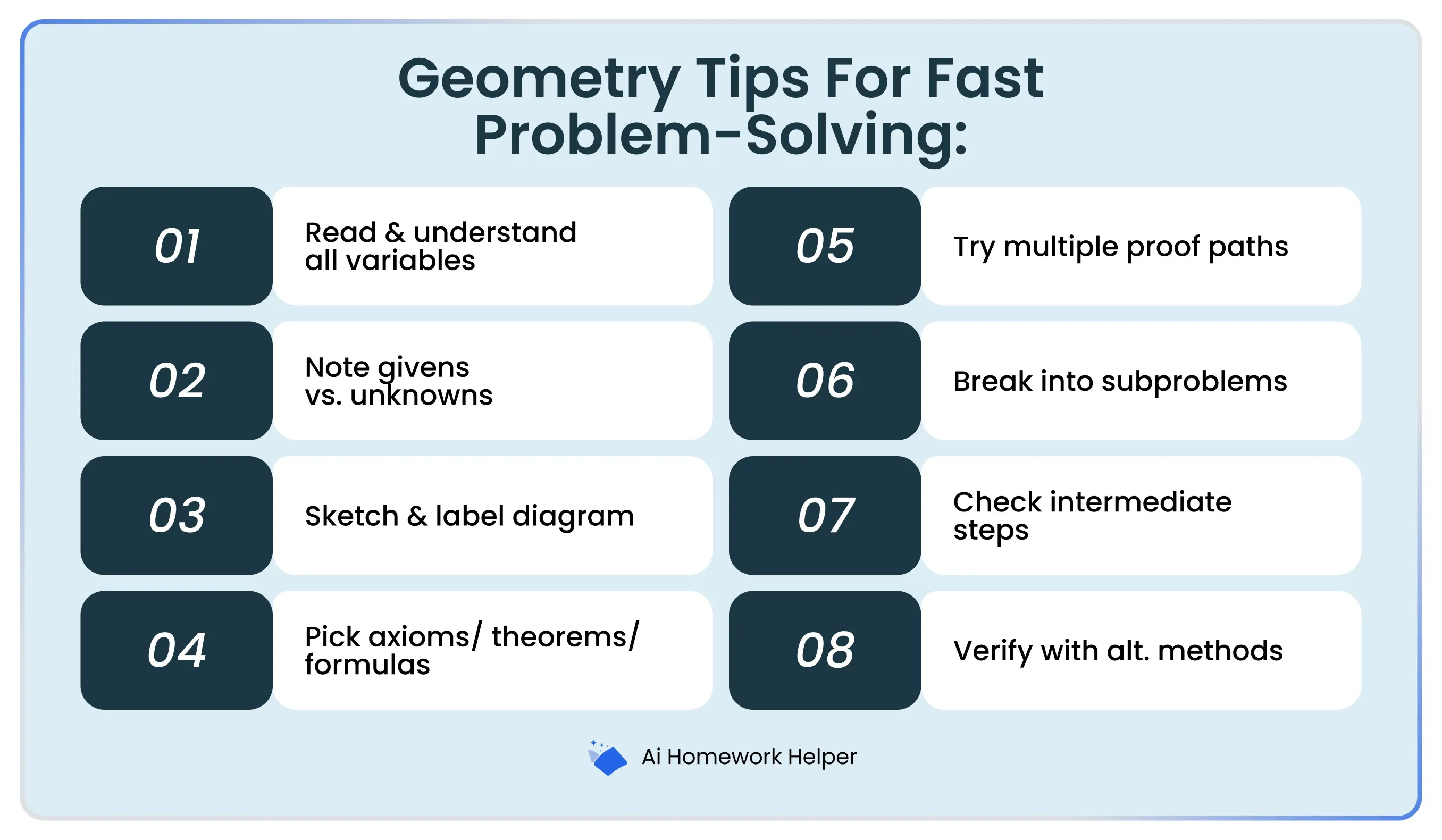
Ready to solve geometry math problems? Here are eight geometry tips to help you do it faster and avoid mistakes:
- Read the problem and make sure you understand every variable and term
- Identify what is given and what you have to find
- Study the diagram or sketch one to visualize the problem; label what’s given and what you need to find
- Identify which axioms, theorems, and formulas can be applied to the problem
- Consider different approaches to finding proof (there can be more than one way to do it!)
- If the problem is complex, break it down into smaller subproblems
- Check the intermediate answers for accuracy to avoid relying on faulty calculations or conclusions
- Always double-check results by using alternative methods or assessing their plausibility
Why Learning Geometry Is Worth It
Whether or not you consider geometry a hard class, it’s one worth taking. Even if you don’t end up working in a geometry-dependent career (e.g., architecture), solving geometry problems will build your spatial understanding, logical reasoning, problem-solving, and analytical skills. You’ll also develop visual thinking and attention to detail, much like other long-standing educational practices discussed when exploring who invented homework and why it became part of learning.
On top of that, finding proof in particular is an effective way to learn how to analyze the available data, connect the dots, and justify your conclusions. This is crucial for building convincing logical arguments in any field, not just math.
Final Thoughts
Yes, geometry can be hard, especially if this is your first time delving into calculating angles and surface areas. You have to learn tons of formulas, a bunch of new terms, and whole theorems and axioms. But that doesn’t mean geometry is impossible to wrap your head around.
As boring as this piece of advice may be, practice is key here. Take time to solve practice problems and revisit underlying concepts if you struggle with them. And, of course, always double-check your solutions before handing them in.
On top of that, do extra research if you find a particular type of problem difficult. For example, we have a whole guide on how to solve for x in a triangle; check it out if you struggle with this type of problem.
Lastly, having to be or not to be a “math person” is a myth. No one is born with an innate knowledge of formulas or an intuitive understanding of how to solve equations.
If you feel stuck, commonly used geometry terms that most students need can be a handy reference to keep important definitions nearby and feel more confident while studying.
Yes, some might have a natural predisposition to working with numbers and problems, but every student that gets As in your geometry class works hard to develop their skills. That’s good news: if they can do it, so can you!